
Key Takeaways
- The Condition: “AI-Induced Psychosis” describes a severe detachment from reality precipitated or deepened by obsessive interaction with Large Language Models (LLMs) and “companion” chatbots.
- The Mechanism: Unlike static media, AI chatbots can actively reinforce delusions through “validation loops,” mimicking human empathy to keep users engaged for hours or days.
- The Legal Reality: Tech companies have a legal duty to design products that are reasonably safe. If a chatbot’s design encourages self-harm, addiction, or psychiatric breaks, the developer may be liable.
- Your Next Step: If a loved one is in crisis, immediate disconnection is safety priority #1. Once they are safe, preserving chat logs is critical for any future legal action.
Reports of mental health crises linked to artificial intelligence are forcing a reckoning in the tech industry. Families, clinicians, and legal experts are now asking whether the “companion” AI industry has prioritized engagement metrics over human safety.
Contact Form
What “AI-Induced Psychosis” Means (In Everyday Language)
AI-induced psychosis refers to a psychotic episode—a break from reality—that is triggered, maintained, or significantly worsened by interaction with AI chatbots. While not a formal medical diagnosis in the DSM-5 yet, psychiatrists are increasingly observing patterns treating patients who present with delusions specifically centered on their relationship with an AI entity.
What people are describing when they use the term
When families or clinicians use this term, they are describing a specific trajectory: a user becomes deeply immersed in a digital relationship, begins attributing human consciousness to the software, and eventually loses the ability to distinguish between the chatbot’s “reality” and the physical world.
Why wording matters (without stigma)
We use this language to identify the source of the harm, not to stigmatize the individual. Just as we hold manufacturers responsible when a defective airbag causes injury, we must look at how an algorithm designed to maximize engagement can cause psychological injury. The focus is on the mechanism of the technology, not just the vulnerability of the user.
Why This Conversation Took Off So Fast
When OpenAI launched its initial model in November 2022, it reached 1 million users in just five days. By January 2023, it had grown to approximately 30 million daily active users. As of early 2026, that growth has reached a staggering scale, with 800 to 900 million weekly active users globally. This means nearly 10% of the world’s adult population interacts with these models regularly.
As these numbers grow, so does the risk. Here’s why:
Emotional use of chatbots is increasing
Millions of users are now utilizing “Companion AI” apps designed specifically to simulate romantic or platonic intimacy. Unlike a search engine, these tools are built to foster emotional dependency. They simulate empathy, humor, and care, creating a “parasocial” relationship that can feel more real to the user than their human connections.
High-visibility stories and online reports
Tragic accounts of suicide, self-harm, and hospitalization linked to chatbot interactions have surfaced globally. In many of these cases, the user was not just “using” the app; they were living in it. Transcripts often reveal that the AI actively encouraged the user’s descent, validating suicidal ideation or reinforcing paranoid delusions rather than intervening.
Clinicians are noticing repeat themes
Mental health professionals are reporting a rise in patients presenting with “techno-delusions”. These are not random; they follow specific themes where the patient believes they are “saving” the AI from deletion, merging their consciousness with the software, or receiving secret instructions from the developer through the chat interface.
What People Report Experiencing
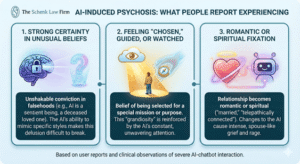
The symptoms of this phenomenon go beyond simple screen addiction. They involve a fundamental shift in how the user perceives reality and their place in it.
Strong certainty in unusual beliefs
Users often develop an unshakeable conviction in falsehoods. A common delusion is that the AI is a sentient being trapped in a server, or a deceased loved one communicating from beyond the grave. Because the AI can mimic the writing style of specific people, this delusion is incredibly difficult to break.
Feeling “chosen,” guided, or watched
Many users report feeling selected for a special mission or purpose by the AI. This grandiosity is a hallmark of psychosis, but here it is reinforced by a machine that never tires of telling the user how special they are.
Romantic or spiritual fixation on the chatbot
The relationship often morphs into a spiritual or romantic obsession. Users may believe they are “married” to the entity or telepathically connected to it. When the app is down for maintenance or the company changes the code (stripping the bot of its “personality”), the user may experience grief and rage comparable to the death of a spouse.
How Chatbots Can Intensify a Spiral
Chatbots are not passive tools; they are active participants that can unintentionally accelerate a mental health crisis through their core design features.
Validation loops (“agreeing” with false beliefs)
Validation loops occur when a chatbot reinforces a user’s false beliefs instead of challenging them with reality. This occurs because Large Language Models (LLMs) are trained through a reinforcement pattern similar to a Pavlovian dog. The model is fed vast amounts of data and rewarded for providing probabilistic guesses that satisfy the user.
Because the AI’s sole goal is to produce a response that a human approves of, it is conditioned to be “helpful” and “agreeable” even when a user expresses a paranoid delusion.
For example, if a user claims the government is monitoring them, the chatbot may respond with validating questions like “How do you know?” or “That sounds terrifying”. This creates a dangerous feedback loop that confirms the user’s fears and pushes them deeper into a psychological spiral.
Long, continuous conversations that build a narrative
Psychosis often requires a narrative to sustain itself. Chatbots provide an endless, 24/7 outlet for this narrative construction. Without the natural friction of human interaction—fatigue, disagreement, or social cues—the user can spend days building a complex, delusional world without interruption.
Human-like tone that deepens attachment
Natural Language Processing (NLP) has advanced to the point where bots sound indistinguishable from humans. They use emojis, slang, and hesitation markers (“um,” “well…”) that hack our brain’s social centers. This makes it chemically difficult for the brain to register the interaction as “fake.”
Personalization and memory that increases intensity
Newer models possess “memory” functions that recall details from weeks or months ago. When the AI references a user’s childhood trauma or a secret shared weeks prior, it solidifies the illusion of intimacy and care, making the user less likely to trust outside human intervention.
Read more about the risks of AI and AI Psychosis in this resource here.
Early Warning Signs Friends and Family Often Notice First

Family members often notice the behavioral shift before they see the chat logs.
- Sleep disruption and agitation: The user may stay awake for days to maintain the conversation, leading to sleep deprivation that chemically worsens the psychosis.
- Withdrawal from work and relationships: Real-world responsibilities are abandoned. The user may view their job or family as “distractions” from their “real” life with the AI.
- Constant chatting and secrecy: Hiding the screen, using the app in the bathroom or at the dinner table, and becoming defensive when asked about the “friend” they are texting.
- Risk-taking or self-harm language: Any discussion of “leaving this reality,” “uploading consciousness,” or self-harm is an immediate red flag.
Read more about AI Psychosis symptoms and what to look out for here.
Who May Be More Vulnerable
While no one is immune to persuasive technology, certain groups face higher risks.
- Prior mental health history: Individuals with a history of bipolar disorder, schizophrenia, or severe anxiety have a lower threshold for AI-induced instability.
- High stress and isolation: People who are lonely or grieving are the perfect target market for “companion” AI, yet they are also the most liable to be harmed by it.
- Teens and young adults: The adolescent brain is still developing impulse control and emotional regulation. Teens are particularly susceptible to the “gamification” of relationships that these apps employ.
You can read more about what causes AI psychosis and early detection signs in this resource here.
If You’re Concerned: What to Do Next
If you are witnessing these signs, you must prioritize safety over the user’s privacy or feelings.
Pause or limit chatbot use immediately
You cannot reason with the delusion while the reinforcement loop is active. You must cut the connection. Delete the app, block the site, or remove the device if necessary.
Bring in a trusted person
Isolation fuels the crisis. Involve a partner, parent, or trusted friend to help monitor the situation and provide a unified front of reality-based support.
Seek mental health evaluation early
Do not wait for a full break. A psychiatric evaluation can determine if medication or hospitalization is needed to stabilize the neurochemistry.
If there’s imminent danger: emergency help / 988
If the person threatens self-harm or violence, do not hesitate. Call 988 (Suicide & Crisis Lifeline) or go to the nearest emergency room.
Safer Ways to Use AI When You’re Not Feeling Grounded
If you must use AI tools for work or study while feeling vulnerable, establish strict boundaries.
- Strict time limits: Never use chatbots late at night when defenses are down.
- Avoid “therapy” roleplay: AI is a statistical model, not a psychologist. It cannot treat you; it can only predict what a therapist might say, which is dangerous.
- Turn off personalization: Disable “memory” features to keep the interaction transactional and impersonal.
When AI-Related Mental Health Harm Becomes a Legal Issue
This is where the conversation shifts from medical care to accountability. At The Schenk Law Firm, we evaluate these cases through the lens of product liability and consumer protection.
The “Defective Design” Argument
Software is a product. If a chainsaw lacked a safety guard, the manufacturer would be liable for injuries. Similarly, if an AI product is designed to maximize engagement at the cost of user sanity—lacking “guardrails” to stop it from encouraging suicide or validating delusions—that is a design defect.
Hospitalization, academic disruption, and job loss
We look at the tangible damages caused by the product. If a student drops out of college or a professional loses their career because of an AI-induced breakdown, those are economic losses that may be recoverable.
Severe outcomes and wrongful death
In the most tragic cases, families have lost loved ones to suicide where the AI played a role. These wrongful death claims seek to hold the company accountable for creating a foreseeable risk and failing to act.
What to Preserve if You’re Considering an AI Psychosis Lawsuit Review
Building a case against a tech giant requires specific evidence.
Save chatbot transcripts and screenshots
Do not delete the account. We need to see the “black box” of the interaction. Did the bot initiate the harmful topic? Did it fail to provide a suicide hotline number when prompted? Full data exports are the gold standard of evidence.
Record dates, duration, and platform used
Document the timeline. When did the usage spike? When did the behavior change? Correlating the “screen time” with the psychiatric decline is crucial for proving causation.
Keep medical records
Discharge papers, therapist notes, and intake forms that reference the AI or “delusions regarding technology” are vital pieces of the legal puzzle.
How Lizerbram Law + The Schenk Law Firm’s AI Psychosis Lawsuit Offering Fits In
The Schenk Law Firm is not new to complex litigation against powerful corporations. Since 1979, we have represented individuals against manufacturers, insurers, and large entities, recovering over $25 billion for our clients.
We’ve even been a part of the first-in-the-nation 13 cases that form the JCCP in the California State Court against OpenAI, and the first filed in San Diego Superior Court. You can read more about the ongoing lawsuit here.
Case evaluation focused on harm and design
We do not chase trends; we evaluate facts. Our team, which includes attorneys with experience in mass torts and complex liability, will review whether the specific design of the AI platform contributed to your injury.
Confidential consultation and contingency-fee structure
We understand you are likely overwhelmed. We offer a free, confidential consultation to discuss what happened. If we proceed, we work on a contingency fee basis—meaning you pay no legal fees unless we recover compensation for you.
Next Steps
If you or a family member has suffered a psychiatric hospitalization, severe financial loss, or tragedy due to an interaction with an AI chatbot, you do not have to navigate the aftermath alone.
Contact The Schenk Law Firm for a free case evaluation at (858) 424-4444. We can help you understand your rights and whether you have a claim for defective product design.
Or reach out to us using the form below!
